 ภาษาไทย
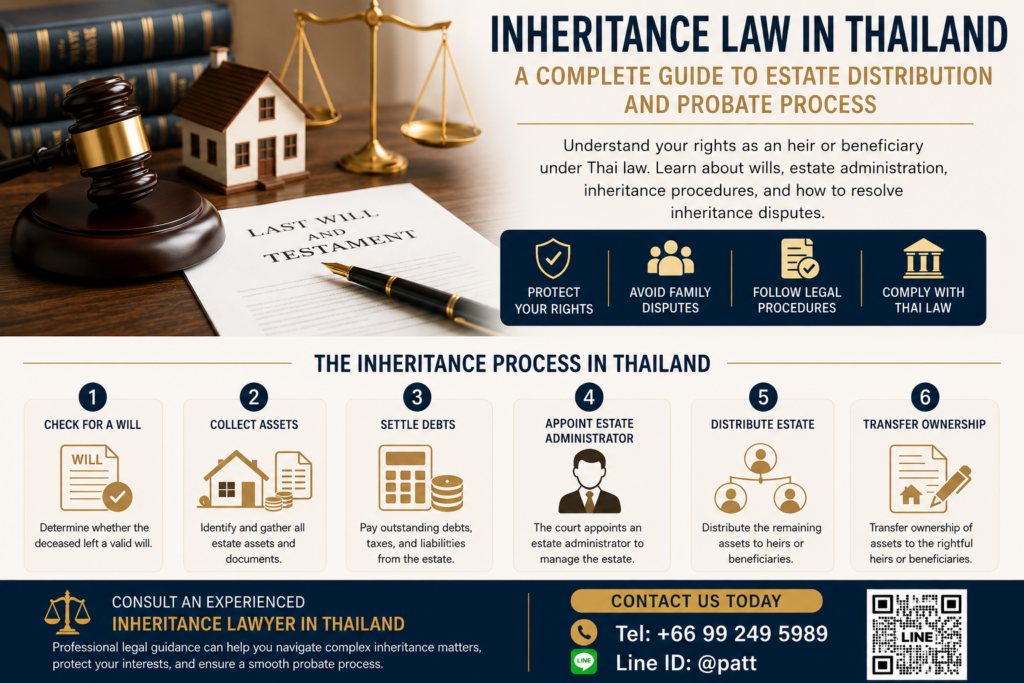
Short answer: when a person dies in Thailand, their property, rights, duties and liabilities pass to their heirs. If there is a valid will, the named beneficiaries take what it gives them. Otherwise, the estate passes to statutory heirs in a fixed order, with the surviving spouse taking a share set by formula. Heirs are not liable for the deceased’s debts beyond what they inherit. Claims to an inheritance are subject to a short limitation period, often one year.
This guide explains the core rules of the Thai Civil and Commercial Code (CCC), Book VI (Succession), for foreign heirs, spouses of Thai nationals and international families with assets in Thailand. Thailand has no probate system in the common-law sense; estate matters follow the CCC and, where needed, a Thai court order appointing an estate administrator.
What forms the estate?
Under CCC Section 1600, the estate comprises all property of the deceased, together with their rights, duties and liabilities, except those that by law or by their nature are purely personal to the deceased.
Typical estate assets include:
- Bank deposits in Thailand
- Land, houses and condominium units
- Vehicles
- Shares, securities and investment funds
- Money owed to the deceased
- The deceased’s debts and liabilities
Do heirs inherit the deceased’s debts?
Only up to the value of what they inherit. An heir is not liable beyond the estate property that passes to them (CCC Section 1601). If the deceased owed THB 5 million but left assets worth THB 1 million, creditors can recover from the estate up to that amount; heirs do not pay the shortfall from their own assets.
The CCC also links debts to distribution:
- While estate creditors remain unpaid, the estate is treated as still under administration, and the administrator must distribute once creditors are paid (Section 1736).
- Before distribution, an estate creditor may enforce the full debt against the estate. After distribution, a creditor may claim from each heir only up to what that heir received (Section 1738).
- Estate debts are paid in a statutory order, for example common estate expenses, funeral costs and unpaid taxes before ordinary debts, without prejudice to secured creditors and holders of special preferential rights (Section 1739).
Who inherits?
There are two kinds of heir: beneficiaries under a will, and statutory heirs.
If there is a valid will
Property passes as the will directs. Beneficiaries may be family members, other individuals, foundations or charities. A will or clause made in breach of certain formal requirements of the CCC is void (Section 1705). Property not effectively disposed of by a valid will passes to the statutory heirs.
Foreigners who made a will abroad, or whose estate includes assets in several countries, may face conflict-of-laws questions about which law governs validity and succession. Those rules are outside this article and should be reviewed by a lawyer.
If there is no will: the six classes of statutory heirs
The CCC recognises six classes of statutory heirs only (Section 1629):
- Descendants (children, grandchildren)
- Parents
- Full brothers and sisters
- Half brothers and sisters
- Grandparents
- Uncles and aunts
An illegitimate child acknowledged by the father, and an adopted child, are treated as descendants just like a legitimate child (Section 1627).
Two rules that are often misunderstood (Section 1630):
- While any heir in an earlier class survives, heirs in later classes take nothing. If the deceased left children, their siblings do not inherit.
- Exception: if descendants and the deceased’s parents are both alive, the parents share as if they were children.
How much does a surviving spouse inherit?
A surviving spouse is a statutory heir, but the share depends on which other heirs survive (Section 1629, final paragraph, with Section 1635). In practice this means a spouse whose marriage was registered under Thai law, or otherwise recognised as valid.
| Other heirs who survive | Spouse’s share |
|---|---|
| Descendants (children, grandchildren) | The same share as a child |
| Parents (no descendants), or full siblings | One half of the estate |
| Half siblings, grandparents, or uncles and aunts | Two thirds of the estate |
| No statutory heirs in any class | The whole estate |
Separate marital property first. Before the estate is calculated, property held between the deceased and the surviving spouse must be divided; the spouse’s own portion is not part of the estate (Section 1625). That section was amended by the Civil and Commercial Code Amendment Act (No. 24) B.E. 2567 (2024), so its current wording should be checked.
Worked example (hypothetical)
Mr A dies without a will in Bangkok. He leaves a registered wife, two children, and both of his parents. After marital property is separated and debts are paid, the net estate is THB 5 million.
The heirs are the two children, the wife (sharing as a child) and the father and mother (each sharing as a child under Section 1630, paragraph 2). That makes five equal shares of THB 1 million. Mr A’s siblings receive nothing because first-class heirs survive. (Illustration of the general rule only; real outcomes depend on the facts.)
How an estate is administered and divided
- Check for a will and whether it complies with Thai formal requirements.
- List the assets: land, houses, condominiums, vehicles, bank accounts, shares, funds, gold and digital assets.
- Separate marital property if the deceased was married.
- Identify debts: bank loans, credit cards, unpaid taxes and judgment debts.
- Appoint an estate administrator where needed, for example when a bank or land office requires a court order, or heirs cannot agree.
- Pay estate debts, then distribute to heirs and beneficiaries.
Estate administrators in Thailand
An heir, any interested person or the public prosecutor may apply to the Thai court to appoint an estate administrator in the cases set out in Section 1713, including where an heir is outside Thailand or a minor, or where there are obstacles to administration or division. The court follows the will if it names an administrator; otherwise it appoints whoever best serves the estate, having regard to the deceased’s intentions. For heirs abroad, this provision is often the practical route to unlocking Thai bank accounts and land.
The administrator must do what is necessary to administer and divide the estate (Section 1719), within statutory deadlines:
| Duty | General deadline |
|---|---|
| Begin the inventory | Within 15 days of the start of duties (Section 1728) |
| Complete the inventory | Within one month, before at least two interested witnesses (Section 1729) |
| Administer, distribute and account | Within one year, unless the will, a majority of heirs or the court sets otherwise (Section 1732) |
An interested person may ask the court to remove an administrator who neglects their duties, but must do so before the partition of the estate is complete (Section 1727).
Limitation periods: act early
Different claims carry different time limits:
| Type of claim | Limitation period |
|---|---|
| Inheritance claim by statutory heirs | One year from the death, or from when the heir knew or should have known of the death; never more than ten years after the death (Section 1754) |
| Claim under the terms of a will | One year from the death, or from when the heir knew or should have known of the death; never more than ten years after the death (Section 1754) |
| Heirs’ claim concerning estate administration | One year from when the beneficiary knew or should have known of their rights under the will (Section 1754, para. 2) |
Important exception: an heir in possession of undivided estate property may still demand partition even after the Section 1754 period has run (Section 1748). Whether possession qualifies is a question of fact, so heirs living abroad should not rely on it without advice.
Common inheritance disputes
- Forged or defective wills: a party challenging a will must prove the facts, such as signatures, form or witnesses. Formally defective wills may be void (Section 1705).
- Hiding or removing estate assets: an heir who fraudulently conceals or removes estate property, knowing it prejudices other heirs, may be excluded from inheriting, wholly or for the concealed part (Section 1605).
- Transfers before death: property validly transferred before death is not part of the estate. Disputes usually concern whether the transfer was genuine and valid, which turns on the evidence.
- One heir occupying estate land: other heirs keep their shares and may demand division or sue, subject to limitation rules.
- An administrator who will not account: heirs may request accounts, seek removal or bring a claim; dishonest misappropriation may also carry criminal liability.
Foreign heirs should note that separate rules under Thai land law govern whether a foreigner may hold land received by inheritance. Check those rules before any transfer.
Frequently asked questions
Does a child of unmarried parents inherit?
From the mother, yes: a child born to an unmarried woman is her legitimate child (Section 1546). From the father, a child he has acknowledged is treated as a descendant (Section 1627). Whether acknowledgement occurred is a question of fact.
Does an unmarried partner inherit?
Generally not as a statutory heir, unless named in a will. A partner may have a claim to jointly acquired property as a co-owner, which must be proved case by case.
If the deceased had children, do their siblings inherit?
No. Earlier classes exclude later ones (Section 1630), although the deceased’s parents share alongside the children.
Can I handle an inheritance in Thailand from abroad?
Generally yes, through a Thai lawyer acting under a power of attorney. Documents signed abroad usually need notarisation and may need legalisation; confirm requirements for your country.
How long does it take to appoint an estate administrator?
There is no fixed period. It depends on the court, the hearing schedule, the completeness of documents and whether anyone objects.
Do heirs have to pay the deceased’s debts?
Only up to the value of what they inherit (Section 1601). Heirs’ personal assets are not used to pay the deceased’s debts.
Conclusion
Thai inheritance law starts with one question: is there a valid will? If not, the estate passes to statutory heirs in a strict order, parents share alongside children, and the spouse takes a share set by formula after marital property is separated. Heirs are liable for debts only up to what they inherit, and the one-year limitation period runs from knowledge of the death. Early advice matters most for heirs living outside Thailand.
Speak to Our Thai Inheritance Lawyers
If you are dealing with an estate in Thailand, whether as a spouse, child or other heir living abroad, understanding your rights early can prevent costly disputes and missed deadlines.
Pattara Law Firm advises Thai and foreign heirs on inheritance rights and share calculations, applies to Thai courts for the appointment of estate administrators, drafts wills and estate-division agreements, negotiates between heirs and represents clients in inheritance and estate-administration litigation. Our notarial services can assist heirs who need documents certified for use abroad.
We will review your documents and explain the procedure, likely timeframe and risks clearly.
- Telephone: +66 99 249 5989
- LINE Official: @patt
- WhatsApp: +66 99 249 5989
- Email: info@thailandlawyer.com
Need Further Legal Guidance?
You may send us a brief summary of your matter for a preliminary review by our legal team. Alternatively, you can contact us directly via the channels below.
 About the Author


