 ภาษาไทย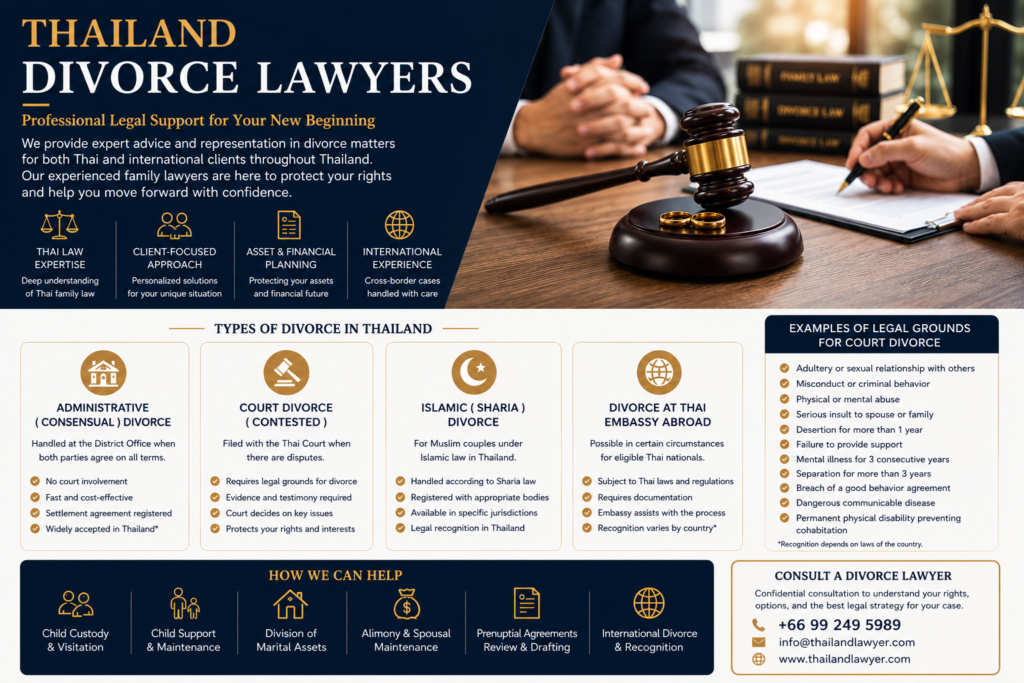
Ending a marriage can involve significant legal, financial, and personal consequences. Whether the parties are Thai nationals, foreign nationals, or part of an international marriage, understanding the available divorce procedures under Thai law is essential before taking action.
Thailand recognizes several legal pathways for divorce, depending on the circumstances of the marriage and the level of agreement between the spouses. The most common forms are administrative divorce and court divorce. In certain regions and specific circumstances, divorces under Islamic law may also be recognized. Thai diplomatic missions abroad may facilitate certain procedures relating to divorce registration for eligible individuals.
Because issues such as child custody, financial support, marital assets, and cross-border enforcement can have long-term consequences, obtaining legal advice before proceeding is strongly recommended.
Administrative Divorce in Thailand
An administrative divorce is generally the simplest method of ending a marriage in Thailand. This process is available when:
- The marriage was registered in Thailand;
- Both spouses agree to terminate the marriage; and
- There are no unresolved disputes regarding custody, support, or division of property.
The divorce is registered at the local District Office rather than through the court system.
Where spouses have agreed on financial matters, parental responsibility, or asset division, a written settlement agreement should be prepared and registered together with the divorce. Proper drafting is important because the agreement may determine each party’s rights and obligations long after the divorce is finalized.
For international couples, it is also important to confirm whether an administrative divorce obtained in Thailand will be recognized in the country where either spouse resides or holds citizenship.
Court Divorce Proceedings
When one spouse does not consent to the divorce, or when significant disputes remain unresolved, the matter may need to proceed through the Thai Family Court.
Court proceedings are commonly required where there are disagreements concerning:
- Child custody arrangements;
- Child support obligations;
- Spousal maintenance;
- Division of marital assets;
- Responsibility for debts; or
- The validity of agreements between the spouses.
To obtain a court-ordered divorce, the petitioner must demonstrate a legally recognized ground for divorce and establish that the Thai court has jurisdiction over the case.
Evidence may include witness testimony, documentary evidence, financial records, communications, photographs, or other materials relevant to the circumstances.
Legal Grounds for Divorce Under Thai Law
Thai courts generally require a legally recognized reason before granting a contested divorce. Examples may include:
- Adultery or maintaining a relationship comparable to marriage with another person;
- Serious misconduct causing harm to the other spouse;
- Physical or psychological abuse;
- Serious insults directed toward a spouse or close family members;
- Desertion for a prolonged period;
- Failure to provide financial support;
- Long-term mental illness under circumstances recognized by law;
- Extended separation from the marital relationship;
- Breach of a written undertaking of good conduct;
- Dangerous communicable diseases affecting marital life; or
- Permanent inability to cohabit as husband and wife due to severe physical conditions.
Whether a particular situation satisfies the legal requirements depends on the specific facts and evidence available in each case.
International Divorce Cases
Cross-border marriages often involve additional legal considerations.
In many situations, Thai courts may have jurisdiction where:
- One spouse is a Thai citizen;
- One spouse resides in Thailand; or
- Relevant events connected to the marriage occurred in Thailand.
Even when one spouse lives overseas, it may still be possible to commence divorce proceedings in Thailand. However, procedural requirements relating to service of documents, court appearances, and evidence must be carefully followed.
If a spouse cannot be located or refuses to participate in the proceedings, Thai law may allow alternative methods of notification subject to court approval.
International divorce matters often require coordination between multiple legal systems, making experienced legal guidance particularly important.
Division of Assets and Debts
Thai family law distinguishes between personal property and marital property.
Personal Property
Assets generally belonging exclusively to one spouse may include:
- Property owned before marriage;
- Certain inheritances;
- Gifts intended solely for one spouse; and
- Other assets classified as personal property under Thai law.
Marital Property
Property acquired during the marriage is often considered jointly owned marital property. This may include:
- Real estate;
- Bank accounts;
- Investments;
- Business interests; and
- Other assets accumulated during the marriage.
In the absence of an agreement between the parties, the court will determine how property should be divided according to Thai law and the specific facts of the case.
Marital debts may also be shared responsibility depending on the purpose for which the debt was incurred and the circumstances surrounding it.
Is No-Fault Divorce Available in Thailand?
Thailand does not operate a fully no-fault court divorce system in the same way as some Western jurisdictions.
However, where both spouses mutually agree to end their marriage and qualify for an administrative divorce, they may complete the divorce process without proving fault before a judge.
In contrast, contested court proceedings generally require the petitioner to establish one or more legally recognized grounds for divorce.
Prenuptial Agreements and Divorce
Thai law recognizes prenuptial agreements that comply with applicable legal requirements.
A properly executed prenuptial agreement may influence:
- Ownership of assets;
- Division of property upon divorce;
- Financial obligations between spouses; and
- Certain rights relating to marital property.
Where a prenuptial agreement was executed outside Thailand, Thai courts will often examine whether the agreement was valid under the law governing its creation and whether it is consistent with applicable legal principles.
Because enforceability can vary depending on the jurisdiction involved, legal review is advisable before relying on any prenuptial agreement in divorce proceedings.
Legal Assistance for Divorce Matters in Thailand
Every divorce case presents unique legal and practical challenges. Whether the matter involves a straightforward administrative divorce, a contested court proceeding, child custody concerns, substantial assets, or international issues, obtaining professional legal advice at an early stage can help protect your rights and facilitate a more efficient resolution.
Our family law team assists Thai and international clients with divorce proceedings, settlement negotiations, asset division, child custody matters, and cross-border family law issues throughout Thailand.
📞 Tel: +66 99 249 5989
💬 LINE Official: @patt
📱 WhatsApp: +66 99 249 5989
📧 Email: info@thailandlawyer.com
Need Further Legal Guidance?
You may send us a brief summary of your matter for a preliminary review by our legal team. Alternatively, you can contact us directly via the channels below.


