 ภาษาไทย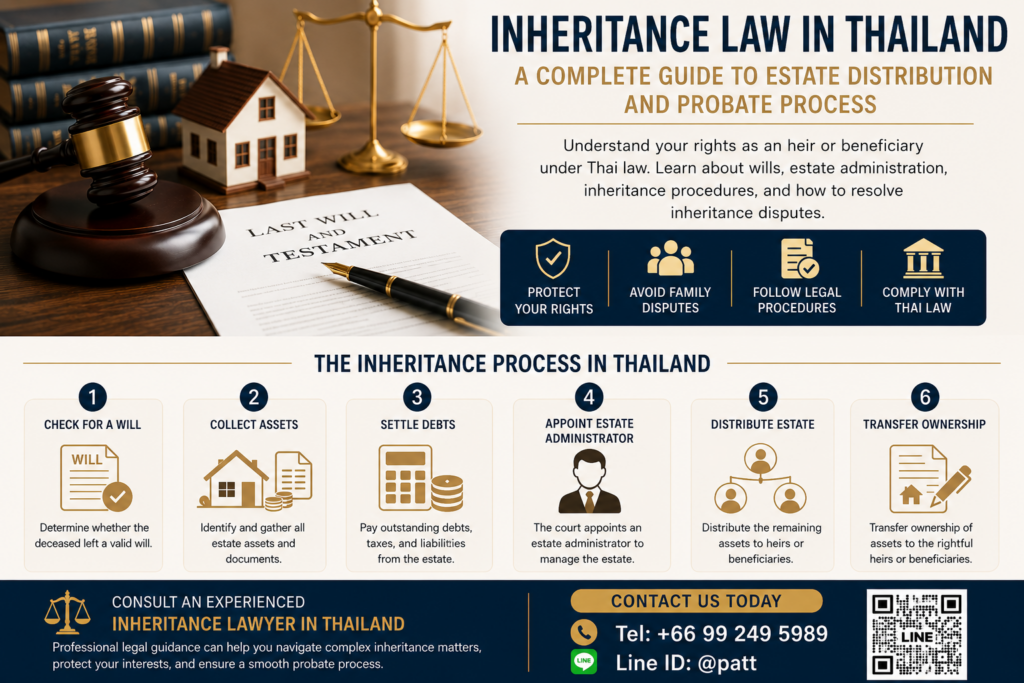
Understanding Inheritance Law in Thailand
When a person passes away, their assets, rights, obligations, and liabilities do not simply disappear. Under Thai law, these legal interests become part of the deceased person’s estate and are transferred to eligible heirs or beneficiaries.
Inheritance matters can become complicated, especially when multiple heirs are involved, valuable assets are at stake, or family members disagree about how the estate should be distributed.
Whether you are a spouse, child, relative, foreign beneficiary, or executor of an estate, understanding Thai inheritance law is essential to protecting your legal rights.
This guide explains the inheritance process in Thailand, who is entitled to inherit, how estates are distributed, the role of an estate administrator, and what to do when inheritance disputes arise.
What Is an Estate Under Thai Law?
According to Section 1600 of the Thai Civil and Commercial Code, an estate includes all property, rights, duties, and liabilities belonging to the deceased at the time of death.
Examples of estate assets include:
- Land and real estate
- Houses and condominiums
- Bank accounts
- Vehicles
- Shares and investments
- Business interests
- Contractual rights
- Intellectual property rights
- Money owed to the deceased
However, certain personal rights that are unique to the deceased do not pass to heirs. For example, obligations requiring the deceased’s personal skills, services, or performance generally terminate upon death.
Do Heirs Inherit the Debts of the Deceased?
A common concern among heirs is whether they will become personally liable for the deceased person’s debts.
Under Thai law, heirs are only responsible for debts up to the value of the estate they receive.
Example
If the deceased leaves:
- Assets worth THB 1,000,000
- Debts worth THB 5,000,000
The heirs will not be personally responsible for the additional THB 4,000,000 beyond the value of the inherited estate.
This legal protection prevents heirs from being burdened with excessive financial liabilities.
Before any estate distribution occurs, outstanding debts must generally be settled from estate assets.
Who Has the Right to Inherit Under Thai Law?
Inheritance in Thailand can occur through:
- A valid Will
- Statutory inheritance (when there is no Will)
Inheritance Through a Will
A person may create a legally valid Will specifying how their assets should be distributed after death.
Beneficiaries under a Will may include:
- Children
- Spouses
- Relatives
- Friends
- Charitable organizations
- Foreign nationals
When a valid Will exists, the estate is generally distributed according to the deceased’s wishes.
However, legal challenges may arise if:
- The Will is alleged to be forged
- The Will was improperly executed
- The deceased lacked legal capacity
- Undue influence is suspected
Inheritance Without a Will
When a person dies intestate (without a Will), Thai law determines who inherits the estate.
The Civil and Commercial Code establishes six classes of statutory heirs.
Class 1: Descendants
This includes:
- Legitimate children
- Legally recognized children
- Adopted children
Descendants have priority over all other classes of heirs.
Class 2: Parents
The deceased’s legal father and mother may inherit if no higher-ranking descendants exist.
Class 3: Full Siblings
Brothers and sisters sharing both parents with the deceased.
Class 4: Half-Siblings
Brothers and sisters sharing either the same father or the same mother.
Class 5: Grandparents
Grandparents may inherit if no closer heirs survive.
Class 6: Uncles and Aunts
This class applies only when no higher-ranking statutory heirs remain.
Does a Spouse Have Inheritance Rights in Thailand?
Yes.
A legally registered spouse is always entitled to inherit under Thai law.
The spouse’s inheritance share depends on which class of statutory heirs survives the deceased.
Importantly, marital property issues must be addressed before estate distribution begins.
In many cases, the surviving spouse is entitled to receive their portion of marital property first, with only the deceased’s share becoming part of the estate.
This distinction is particularly important in cases involving:
- Real estate
- Family businesses
- Joint bank accounts
- Investment portfolios
The Estate Distribution Process in Thailand
Understanding the legal process helps avoid unnecessary delays and disputes.
Step 1: Determine Whether a Will Exists
The first step is identifying whether the deceased left a valid Will.
The Will may specify:
- Beneficiaries
- Asset distribution
- Appointment of an executor or estate administrator
If a valid Will exists, it generally governs the administration of the estate.
Step 2: Identify Estate Assets
A complete inventory of assets should be prepared.
Common estate assets include:
- Land and houses
- Condominium units
- Vehicles
- Bank deposits
- Securities
- Business ownership interests
- Digital assets
Proper asset identification is crucial to ensure transparency and prevent allegations of concealment.
Step 3: Identify Outstanding Debts
The estate administrator should review:
- Mortgage obligations
- Bank loans
- Credit card debts
- Tax liabilities
- Court judgments
These liabilities generally must be addressed before distributing assets to heirs.
Step 4: Appointment of an Estate Administrator
One of the most important stages in Thai probate proceedings is appointing an estate administrator.
The estate administrator may be:
- Named in the Will
- An heir
- A person with a legal interest in the estate
The appointment is typically approved by the Thai court.
What Does an Estate Administrator Do?
An estate administrator has authority to manage and protect estate assets.
Their responsibilities often include:
- Collecting estate assets
- Managing estate property
- Paying debts
- Representing the estate in legal proceedings
- Coordinating with banks and government agencies
- Distributing assets to beneficiaries
Because the estate administrator acts in a fiduciary capacity, they must perform their duties honestly and in the best interests of all heirs.
How Long Does Probate Take in Thailand?
The timeline varies depending on:
- Court workload
- Complexity of the estate
- Number of heirs
- Whether disputes arise
In uncontested cases, appointing an estate administrator may take approximately two to six months.
More complex inheritance disputes may take significantly longer.
Common Inheritance Disputes in Thailand
Inheritance litigation frequently arises when family members disagree about their rights.
Common disputes include:
Disputes Over Real Estate
Property often represents the largest asset within an estate.
Conflicts commonly occur regarding:
- Land ownership
- Occupation rights
- Sale of inherited property
- Partition of jointly inherited land
Concealment of Estate Assets
Sometimes an heir controls estate assets without disclosing them to other beneficiaries.
Examples include:
- Hidden bank accounts
- Undisclosed investments
- Unreported property ownership
Such conduct may lead to legal proceedings.
Challenges to a Will
A Will may be challenged on grounds such as:
- Forgery
- Lack of witnesses
- Mental incapacity
- Fraud or coercion
The court may invalidate a Will if legal requirements were not satisfied.
Estate Administrator Misconduct
Disputes sometimes arise when an estate administrator:
- Fails to provide information
- Delays distribution
- Misappropriates assets
- Acts contrary to court orders
In such circumstances, the court may remove or replace the administrator.
Filing an Inheritance Lawsuit in Thailand
When heirs cannot reach an agreement, litigation may become necessary.
An inheritance lawsuit may involve:
- Estate distribution claims
- Challenges to a Will
- Recovery of estate assets
- Removal of an estate administrator
- Determination of heirship rights
Inheritance litigation often requires detailed legal analysis and documentary evidence.
Seeking legal advice early can significantly improve the likelihood of a favorable outcome.
Limitation Periods in Inheritance Cases
Time limits are extremely important in inheritance matters.
Under Thai law, inheritance claims are generally subject to limitation periods.
In many situations:
- Claims must be brought within one year from the date the claimant knew or should have known of their inheritance rights.
- Claims may not be brought later than ten years after the death of the deceased.
Failure to act within the legal time limit may result in the loss of inheritance rights.
Why You Should Consult a Thai Inheritance Lawyer
Inheritance matters frequently involve complex legal and procedural issues.
Professional legal assistance can help:
- Verify inheritance rights
- Review Wills
- Appoint an estate administrator
- Protect estate assets
- Resolve family disputes
- Represent clients in probate proceedings
- Conduct inheritance litigation
For foreign nationals with property, investments, or family members in Thailand, legal guidance is particularly important because inheritance issues often involve both Thai law and foreign legal considerations.
Frequently Asked Questions About Inheritance in Thailand
Can a foreigner inherit property in Thailand?
Foreigners may inherit certain assets in Thailand, although restrictions may apply, particularly regarding land ownership.
Legal advice should be obtained before taking any action.
Can an illegitimate child inherit?
A child may inherit if legally recognized under Thai law.
The specific circumstances should be carefully reviewed.
Is probate required in Thailand?
In most cases, court appointment of an estate administrator is necessary before estate assets can be transferred.
What happens if heirs cannot agree?
The dispute may be resolved through negotiation, mediation, or litigation before the Thai courts.
Contact an Experienced Thai Inheritance Lawyer
If you are dealing with:
✓ Estate administration in Thailand
✓ Appointment of an estate administrator
✓ Probate proceedings
✓ Inheritance disputes
✓ Real estate inheritance
✓ Challenges to a Will
✓ Distribution of estate assets
✓ Cross-border inheritance matters
Consulting an experienced Thai inheritance lawyer can help protect your rights and ensure compliance with Thai law.
Contact Thai Inheritance Lawyer:
📞 Tel: +66 99 249 5989
💬 LINE Official: @patt
📱 WhatsApp: +66 99 249 5989
📧 Email: info@thailandlawyer.com